Leave Your Message
Choosing the right Square Water Tanks in 2026 requires more than comparing prices or external dimensions. Storage capacity matters, but so do water quality, installation space, structural strength, and maintenance access. The WHO and UNICEF Joint Monitoring Programme reported that 2.2 billion people lacked safely managed drinking water in 2022. This figure highlights a practical reality: reliable storage remains essential, even where mains water is available.
A suitable tank should match its intended use. Drinking water demands materials certified for potable contact, such as products meeting NSF/ANSI 61 where applicable. Agricultural storage may require different coatings, fittings, and cleaning schedules. A tank holding 5,000 litres can exert significant pressure on its base and walls. Square designs save space beside buildings, yet their flat panels may require stronger reinforcement than rounded tanks. That detail is easy to miss.
Check local building, plumbing, and rainwater regulations before ordering. Standards such as AWWA D100 and D103 provide useful guidance for certain steel tank applications, but they do not certify every product. Manufacturer data should state capacity, wall thickness, UV resistance, warranty terms, inlet sizes, and safe installation requirements. The U.S. EPA also emphasizes source protection and water-system reliability, reminding buyers that storage quality affects the wider system.
A neat tank can still be the wrong tank. Measure doorways, foundations, drainage paths, and cleaning clearance. Leave room for inspection. In 2026, the best choice will balance usable capacity, verified materials, service life, and realistic site conditions—not marketing claims alone. The final decision should be documented and reviewed by a qualified installer.
How to Choose the Best Square Water Tanks in 2026?
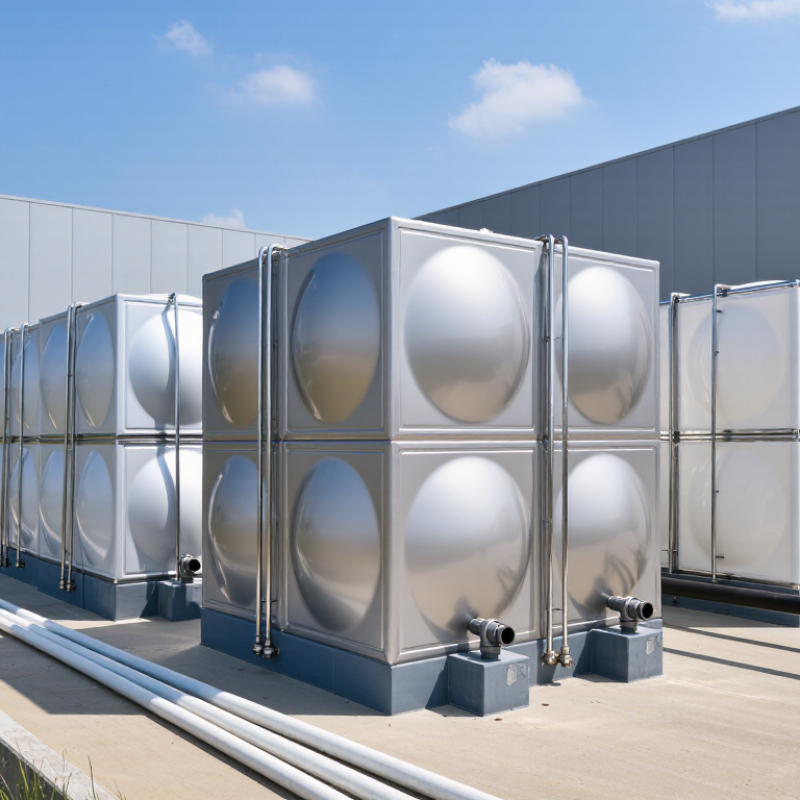
Square water tanks come in several practical forms. Rotomolded polyethylene tanks are lightweight, corrosion-resistant, and suitable for homes or small farms. Sectional steel tanks offer larger capacities and easier transport through narrow entrances. Concrete tanks remain useful for permanent underground storage, although installation requires stronger foundations and careful waterproofing. Stainless steel models suit commercial sites where hygiene and cleaning access matter.
Capacity is not everything. The tank’s main application should guide the choice. The WHO and UNICEF Joint Monitoring Programme reported that 2.2 billion people lacked safely managed drinking water in 2022. This highlights the importance of sealed covers, food-contact certification, and protected inlet pipes for household storage. For agriculture, the FAO reports that farming uses about 70% of global freshwater withdrawals. A tank with a wide outlet, stable base, and simple level monitoring can support irrigation more reliably. Fire reserves need different planning, including dedicated volume and rapid access.
Placement changes everything. A square tank fits neatly beside walls, sheds, and factory corridors, but full water weight creates serious structural pressure. My first oversized tank looked efficient, yet its foundation needed costly reinforcement. That mistake still matters. Buyers should check sunlight exposure, cleaning frequency, local temperature, and delivery access before comparing prices. Industry guidance often emphasizes maintenance, but real users sometimes forget the access hatch. That small detail can make routine inspection frustrating. Tank selection is therefore a balance between water quality, usable space, structural safety, and the habits of the people maintaining it.
| Square Water Tank Type | Typical Construction | Typical Capacity Range | Common Footprint or Module Size | Main Applications | Key Advantages | Important Considerations | Water-Suitability Notes |
|---|---|---|---|---|---|---|---|
| Molded Polyethylene Tank | One-piece rotationally molded polyethylene with a reinforced top and threaded or flanged outlets. | Approximately 500–5,000 L | Commonly about 0.8–2.4 m wide and 0.8–2.4 m deep; height varies by capacity. | Household rainwater storage, garden irrigation, livestock water, and small commercial facilities. | Lightweight, corrosion-resistant, relatively quick to install, and available in compact footprints. | Large units may require lifting equipment; the supporting base must be level, smooth, and fully supported. | Use only models with materials, fittings, and certification suitable for potable water when drinking-water storage is required. |
| Polyethylene Panel Tank | Factory-produced polyethylene panels assembled with gaskets, bolts, a framed roof, and integrated fittings. | Approximately 5,000–50,000 L | Panelized footprints commonly start near 2 m × 2 m and expand in modular increments. | Schools, farms, construction sites, emergency reserves, and medium-scale rainwater harvesting. | Modular design makes transport and on-site assembly easier than moving a large one-piece tank. | Joint installation quality is critical; the foundation must remain level to prevent uneven loading. | Potable use depends on the panel material, liner, seal, internal coating, and approved fittings. |
| Fiberglass-Reinforced Plastic Panel Tank | Bolted or laminated fiberglass-reinforced plastic panels with sealed joints and a protected internal surface. | Approximately 10,000–500,000 L | Often configured from roughly 2 m × 2 m upward using standard panel modules. | Industrial process water, fire-water storage, municipal reserves, and large commercial buildings. | Good corrosion resistance, modular sizing, and relatively low maintenance when properly installed. | Panel joints, UV exposure, impact protection, and access for inspection must be considered during design. | For drinking water, confirm that the resin, liner, sealants, and fittings meet the applicable local requirements. |
| Galvanized Steel Sectional Tank | Bolted galvanized steel panels with a roof system, internal liner or coating, and external support components. | Approximately 10,000–1,000,000 L | Frequently built from square modules of about 1 m × 1 m or 1.2 m × 1.2 m. | Fire suppression reserves, commercial buildings, agricultural storage, and municipal utility systems. | High structural strength, configurable height and footprint, and suitability for large storage volumes. | Bolts, seals, coatings, and liner condition require periodic inspection; corrosion protection is essential. | Potable applications require an approved internal liner or coating and compatible water-contact components. |
| Stainless Steel Sectional Tank | Bolted stainless-steel panels, sealed joints, structural framing, and an insulated or non-insulated roof. | Approximately 10,000–500,000 L | Usually assembled from square or rectangular panels, commonly around 1 m–1.5 m per side. | Potable-water systems, food and beverage facilities, hospitals, laboratories, and high-hygiene installations. | Strong hygiene performance, smooth cleanable surfaces, and high resistance to many forms of corrosion. | Higher purchase cost; water chemistry, welding or bolting details, insulation, and cleaning access still matter. | Choose the stainless-steel grade and internal components according to the water chemistry and applicable regulations. |
| Concrete Square or Rectangular Tank | Cast-in-place or precast reinforced concrete with a waterproof internal lining or cementitious treatment. | Approximately 20,000–5,000,000 L | Custom-built; dimensions are determined by site conditions, structural design, and required storage volume. | Underground rainwater storage, municipal reservoirs, fire-water reserves, and large agricultural systems. | Very high capacity potential, strong resistance to wind, and efficient use of underground or permanent spaces. | Requires detailed structural design, substantial construction time, curing, waterproofing, and inspection for cracking. | Potable water requires a suitable certified lining or finish and careful control of concrete-related water chemistry. |
| Flexible Pillow or Bladder Tank | Flexible reinforced fabric membrane supported by a low-profile frame or placed on a prepared surface. | Approximately 1,000–500,000 L | Low-profile square or rectangular layouts; dimensions vary widely with volume and available space. | Temporary water storage, disaster response, remote sites, irrigation, and rainwater collection. | Compact when empty, rapid to deploy, and suitable where permanent construction is impractical. | Needs protection from sharp objects, abrasion, excessive heat, animals, and unauthorized access. | Use a membrane specifically approved for the intended water type; potable and non-potable versions are not interchangeable. |
| Insulated Square Roof or Attic Tank | Compact polyethylene or composite tank with insulation, a covered lid, and connections designed for indoor installation. | Approximately 300–3,000 L | Common compact footprints range from about 0.6 m × 0.6 m to 1.8 m × 1.8 m. | Residential water-pressure systems, building service water, indoor rainwater reuse, and frost-prone locations. | Space-efficient, protected from weather, and suitable for locations where a tall cylindrical tank is unsuitable. | Confirm floor or roof load capacity, access for maintenance, ventilation, overflow routing, and leak protection. | For drinking water, use a tank and plumbing components approved for potable contact and prevent stagnation. |